
The Business of Clean/Growth Strategies
The One-Source Advantage: Why B2B Customers Want Fewer Cleaning Vendors
The professional cleaning industry is changing. Property managers, building owners and commercial customers are looking beyond individual cleaning services toward trusted partners who can deliver multiple services, coordinate operations and provide consistent results at scale.
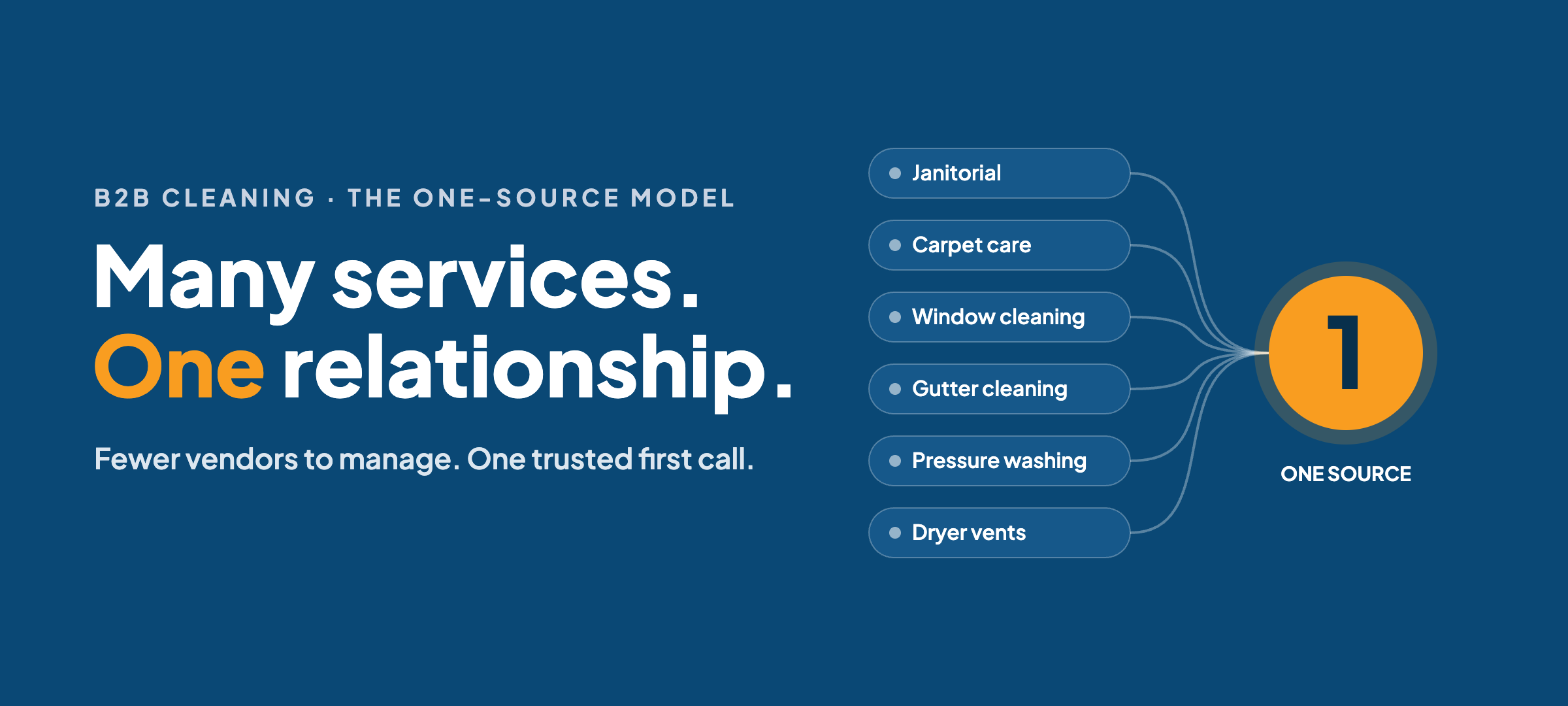
Consider the number of service providers required to maintain a typical commercial or multi-residential building.
One company handles janitorial cleaning. Another cleans the carpets. A third washes the windows. Different contractors handle pressure washing, gutter cleaning and dryer vent maintenance.
Each relationship requires communication, scheduling, quotes, purchase orders, invoices, insurance documentation and follow-up.
Multiply those responsibilities across dozens of buildings, and managing vendors becomes a significant part of a property manager’s workload.
What if one trusted cleaning company could coordinate and deliver many of those services through a single customer relationship?
It’s a question more businesses are considering — and industry research suggests a shift toward greater supplier coordination and consolidation.
The Research: Businesses Are Looking to Consolidate Vendors
The trend toward fewer, more capable service partners is supported by facilities management research.
In March 2026, the International Facility Management Association (IFMA) published findings from JLL’s facilities management research highlighting three important statistics:
- Nearly 60% of surveyed facilities management leaders identified supplier consolidation as their primary cost-reduction strategy.
- 52% of organizations engaged in facilities management partnerships prioritized providers with direct service-delivery capabilities to reduce subcontracting costs.
- 84% of facilities management leaders cited increasing operating costs and budget constraints as major concerns.
Source: IFMA — Beyond Building Operations, March 2026
CBRE’s Managing Corporate Real Estate & Facilities: Leading and Emerging Practices report, published in 2024, similarly found that nearly one-third of respondents expected to consolidate their work with fewer suppliers over the following one to three years.
Source: CBRE — Outsourcing Solutions, 2024
And JLL’s October 2026 Global State of Facilities Management Report, drawing on 1,321 organizations across 15 countries, found that 87% of respondents agreed facilities management outsourcing would shift toward outcome-based pricing by 2030.
Source: JLL — Global State of Facilities Management Report, 2026
These studies cover the broader facilities management industry rather than cleaning services alone. They do not suggest that every customer wants just one vendor for everything.
What they demonstrate is a growing emphasis on supplier coordination, operating efficiency, strategic partnerships and measurable service outcomes.
For cleaning companies, that creates an important opportunity.
Customers Want Fewer Relationships to Manage
For a property manager responsible for 30 residential buildings, cleaning is just one part of the job.
There are council meetings, budgets, building repairs, resident concerns, contractors and ongoing maintenance requirements.
Coordinating six different cleaning companies isn’t necessarily adding value to the property manager’s day.
It may simply be adding work.
Every new vendor brings another relationship to manage:
- Another contact and service agreement.
- Another schedule to coordinate.
- Another invoice to process.
- Another set of insurance and safety documents to track.
- Another company to call when something goes wrong.
A capable one-source cleaning provider can simplify much of that administration.
The property manager has fewer contacts, more coordinated scheduling, consistent service documentation and a clearer path for resolving problems.
The value isn’t simply purchasing more cleaning services from one company. It’s reducing the work required to manage those services.
From Cleaning Contractor to Cleaning Partner
There’s an important distinction between a company that performs individual cleaning jobs and one that manages a broader cleaning relationship.
A traditional contractor might receive a call to pressure wash a parkade, complete the work and send an invoice.
A one-source cleaning partner can take a broader view.
It may already provide the building’s janitorial service, carpet maintenance and annual gutter cleaning. Its team understands the property, the access requirements, the customer expectations and the service history.
When another need arises, the relationship is already established.
The provider can identify upcoming maintenance requirements, recommend appropriate service schedules and coordinate work around the building’s operations.
Instead of responding only when a customer requests a specific service, the company can help the customer plan ahead.
That changes the relationship from transactional to ongoing.
And ongoing relationships create opportunities for stronger customer retention, better service coordination and more predictable business.
One Building. Multiple Services. One Relationship.
Consider a residential apartment building that requires the following services throughout the year:
| Service | Typical delivery model |
|---|---|
| Janitorial Management | Recurring |
| Carpet Maintenance | Scheduled recurring |
| Window Cleaning | Annual or seasonal |
| Gutter Cleaning | Annual or program-based |
| Pressure Washing | Periodic |
| Dryer Vent Cleaning | Scheduled maintenance |
| Building Washing | Periodic |
Traditionally, these services might be purchased from several independent contractors.
A one-source cleaning company can offer multiple services through one established relationship, subject to having the necessary technical capabilities and qualified personnel.
The benefits go beyond convenience.
Service schedules can be coordinated. Property information can be shared between teams. Work can be documented consistently. Customer communication can become more efficient.
For the customer, it’s a simpler way to manage cleaning.
For the cleaning company, it’s an opportunity to develop a much deeper relationship with an existing account.
Scale Matters — Especially for B2B Customers
A company providing services to one building needs operational capability.
A company supporting a property management firm with 100 buildings needs something more.
It needs systems.
Scheduling, dispatching, employee training, safety, reporting, quality control and customer communication must work together.
At that scale, customers need confidence that services can be delivered consistently across multiple properties without creating more administrative work.
This is where technology becomes an important differentiator.
Centralized customer records, digital work orders, field reporting and consistent operating procedures allow service providers to coordinate larger volumes of work.
CBRE’s 2023 Facilities Management Procurement Perspectives report described how outsourced service providers can create efficiencies through supplier relationships, purchasing scale, specialized expertise and performance management.
Source: CBRE — Facilities Management Procurement Perspectives, 2023
For cleaning companies, the lesson is straightforward.
Growth isn’t simply about adding more crews and trucks. It’s about developing the systems and people required to coordinate service delivery at scale.
Why the One-Source Model Is Stronger for Cleaning Companies
The benefits of the model extend to the cleaning company itself.
A business focused on one service may have one primary reason to contact a customer.
For example, a pressure washing company might see a particular building once a year.
But if that same company can also provide carpet maintenance, window cleaning, gutter cleaning and janitorial services, the customer relationship becomes broader and more frequent.
This creates several advantages.
More revenue opportunities from existing customers. Rather than relying exclusively on acquiring new accounts, the company can introduce additional services to customers who already know and trust its team.
A combination of recurring and project revenue. Janitorial contracts and scheduled maintenance programs can create predictable revenue, while specialty cleaning projects provide additional opportunities throughout the year.
Stronger customer relationships. The more effectively a company supports a customer’s ongoing requirements, the more opportunities it has to demonstrate its value.
Better use of sales and marketing resources. Developing an existing relationship may require less prospecting than winning an entirely new customer, although the economics depend on the services and account.
A more diversified business. Multiple service lines can reduce dependence on one category of cleaning work or one seasonal demand cycle.
None of these benefits happens automatically. They depend on pricing, execution, service quality and the ability to deliver each service profitably.
But together, they create a compelling model for business growth.
One-Source Doesn’t Mean One-Size-Fits-All
There’s an important qualification.
Customers aren’t looking for convenience at the expense of quality.
A company that offers ten services but performs only three of them well is not necessarily a better vendor.
Specialty cleaning requires trained technicians, appropriate equipment, technical expertise and well-defined safety procedures.
The strongest one-source providers combine broad capabilities with genuine expertise in each service they deliver.
And customers should still have the flexibility to choose specialists where appropriate.
The objective isn’t to eliminate every other contractor. It’s to become the customer’s trusted first call for a broad range of cleaning requirements.
That trust must be earned through consistent performance.
How Servus® Is Building Around the One-Source Model
At Servus® Cleaning, the one-source approach is central to our business model.
Since 1989, our Lower Mainland operation has developed a range of specialty cleaning and janitorial services serving residential and commercial properties.
Rather than building a franchise around a single cleaning specialty, we’ve combined two complementary service lines:
Specialty Cleaning — Including exterior cleaning, window cleaning, gutter cleaning, floor care, dryer vent cleaning and scheduled maintenance programs.
Janitorial Management — Recurring cleaning and janitorial services for residential and commercial properties.
Together, these service lines give franchise owners opportunities to develop recurring customer relationships while delivering higher-value specialty services to the same accounts.
Our Servus® Enterprise System supports customer management, sales, scheduling, field operations, communication and reporting.
The purpose is to help local owners coordinate a broader range of services without having to develop every operating system independently.
It’s also why we focus on entrepreneurial, sales-driven franchise owners who want to build relationships with property managers, building owners and commercial customers.
The opportunity isn’t simply to sell another cleaning service.
It’s to become a more valuable business partner to the customers you already serve.
The Future Belongs to Companies That Make Business Easier for Their Customers
The professional cleaning industry will always have room for specialized contractors.
But as property portfolios grow and customers face increasing pressure to control costs, simplify administration and deliver consistent results, coordinated service models offer a meaningful advantage.
Customers don’t want more complexity.
They want reliable service, clear accountability, good communication and fewer problems to manage.
Cleaning companies that can deliver those things across multiple services have an opportunity to build stronger customer relationships and more resilient businesses.
The future of professional cleaning isn’t necessarily about doing one thing for more customers.
It’s about doing more of the right things for the customers who already trust you.
That’s the one-source advantage.
Explore the Servus® Cleaning Franchise Model →
The Business of Clean | Servus® Cleaning
Ready when you are