
The Business of Clean/Business Ownership
Business Ownership Isn't for Everyone. Finding the Right Fit Matters.
Owning a business can be one of the most rewarding professional experiences. But it comes with responsibility, uncertainty and a very different relationship with work. Success starts with understanding yourself, choosing the right business and knowing what it really means to be an owner.
There’s something appealing about owning your own business.
The freedom to make decisions. The opportunity to create something valuable. The satisfaction of building a team, serving customers and watching your company grow.
But business ownership isn’t for everyone.
And that’s worth understanding before making the investment.
Being a successful entrepreneur isn’t necessarily about being the smartest person in the room, having the most technical expertise or working the longest hours.
It’s about accepting responsibility, leading people, making decisions and understanding that the business is something you’re building — not simply a job you’ve created for yourself.
Perhaps most importantly, it’s about finding a business that fits your strengths, personality and ambitions.
Ownership Means Carrying Responsibility
When you’re an employee, your responsibilities are generally defined by your position.
When you’re the owner, your responsibilities don’t end with your job description.
You’re responsible for the financial health of the business, the commitments made to customers and the people who depend on the company for their livelihoods.
Some days, that responsibility feels incredibly rewarding.
Other days, it can be uncomfortable.
Customers may be unhappy. Employees may leave unexpectedly. Sales may slow down. Equipment may fail. Cash flow may become tight.
The owner doesn’t necessarily have to solve every problem personally, but they remain accountable for ensuring those problems are addressed.
One of the defining characteristics of a successful business owner is the ability to carry responsibility without allowing every challenge to become a personal crisis.
That requires resilience, sound judgment and the willingness to make decisions when there isn’t a perfect answer.
It’s also why ownership shouldn’t be confused with independence from accountability.
In many ways, business owners are accountable to more people than ever before.
The Business Is Not You
This is one of the most important distinctions an entrepreneur can learn.
You own the business. You are not the business.
A company has its own customers, financial commitments, employees, operating requirements and long-term objectives.
If incorporated, it’s also a separate legal entity, although owners may still have personal guarantees or other legal obligations.
The business should be managed as an organization with its own identity and financial discipline — not simply as an extension of the owner’s personal life.
You might own 100% of the shares, but that doesn’t mean every dollar in the bank account belongs to you personally.
Revenue belongs to the business. Expenses must be covered. Employees and suppliers must be paid. Capital needs to be reinvested.
Your compensation for working in the company is different from the return you may earn through ownership.
Understanding that distinction changes how you make decisions.
Rather than asking, “What do I want from the business today?” you begin asking:
“What does the business need to become stronger, more successful and more valuable tomorrow?”
That shift in thinking is foundational to building a lasting company.
You Work for the Business — Even When You Own It
Every business owner wears two hats.
The first is the owner, responsible for protecting the investment, setting direction and building long-term value.
The second is the operator, responsible for performing a role within the organization.
In a smaller business, the owner may be the salesperson, general manager, estimator and occasional frontline employee.
That’s often necessary in the early stages.
But those are operational roles. They’re not the definition of ownership.
As the company grows, those responsibilities should become clearer, more structured and increasingly transferable to other capable people.
A successful entrepreneur eventually needs to ask:
If I wasn’t the owner, would the business still need someone to perform the job I’m doing?
The answer is usually yes.
That means the role can be defined, measured, trained and eventually delegated.
The goal is to build a business that doesn’t depend entirely on your personal involvement to function.
That’s how owners create more freedom, greater organizational capacity and potentially a more valuable company.
Choose a Business That Fits Who You Are
Not every business opportunity is right for every entrepreneur.
Some businesses are highly technical. Others depend on retail traffic, manufacturing expertise, product development or substantial financial investment.
Service businesses operate differently.
They depend heavily on customer relationships, employee performance, reliable systems and consistent execution.
An entrepreneur who enjoys working independently on technical projects may find the constant communication and people management challenging.
Someone who enjoys building relationships, selling, developing employees and solving business problems may find the service industry a particularly good fit.
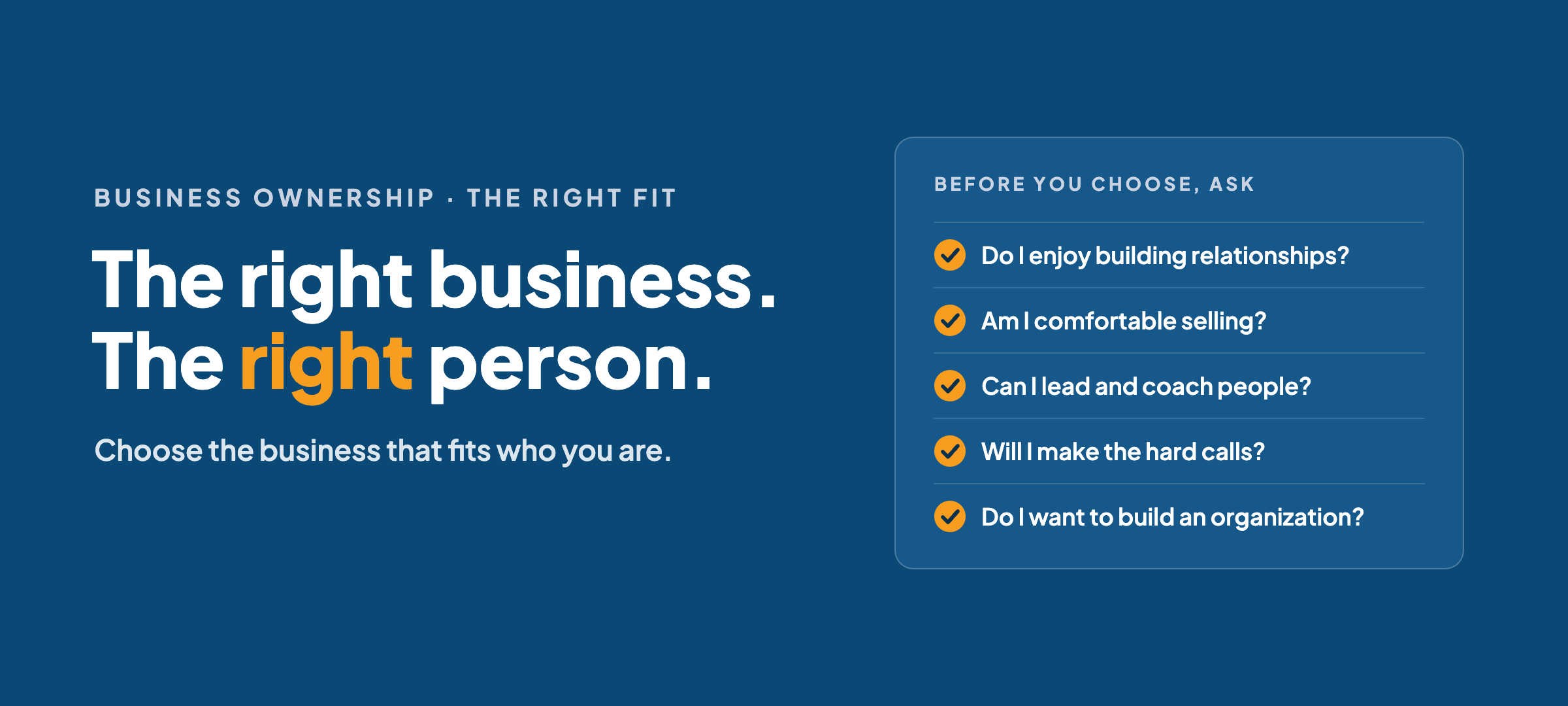
Before choosing a business, it’s worth asking yourself:
- Do I enjoy meeting people and developing customer relationships?
- Am I comfortable selling and asking for business?
- Can I lead, coach and hold people accountable?
- Am I willing to make difficult decisions?
- Can I manage financial uncertainty and accept responsibility?
- Am I interested in building an organization rather than simply performing a trade?
There are no universally right answers.
But there is a right fit.
The best business opportunity isn’t necessarily the one with the most exciting projections. It’s the one that matches your capabilities and gives you a realistic opportunity to succeed.
Why Sales and Leadership Matter So Much in Service Businesses
In the professional cleaning industry, technical expertise is important.
You need to understand how services are delivered, what equipment is required, how to maintain safety standards and how to produce consistent results.
But technical expertise alone doesn’t build a successful cleaning company.
A cleaning business needs customers.
It also needs people who can reliably deliver what has been promised.
That’s why we believe two capabilities are particularly important for owners of service businesses:
The ability to sell and the ability to lead people.
Sales is about more than closing deals.
It’s understanding customer needs, establishing trust, identifying opportunities and developing relationships that last for years.
Leadership is about creating an environment where employees understand their responsibilities, have the tools to succeed and want to contribute to the business.
An owner who can do both has the foundation to build a strong service organization.
The technical skills can be learned. Systems can be introduced. Experienced employees can be hired.
But an entrepreneur needs to be willing to lead the growth of the business.
At Servus® Cleaning, our philosophy is EX + CX = Growth — Employee Experience + Customer Experience = Growth.
That relationship matters because service businesses succeed when employees deliver consistently for customers.
And it takes leadership to make that happen.
Being Good at the Work Isn’t the Same as Being Good at the Business
This is a challenge in many service industries.
A talented cleaner starts a cleaning company.
A skilled plumber opens a plumbing business.
An experienced technician becomes an HVAC contractor.
Initially, their technical abilities help attract customers and establish a reputation.
But eventually the business needs more than technical excellence.
It needs sales management, financial planning, employee development, operational systems and leadership.
The skills required to run the company become different from the skills required to deliver the service.
That doesn’t mean technicians can’t become excellent entrepreneurs. Many do.
But it requires a willingness to evolve from doing the work to managing and growing the organization that performs the work.
The strongest business owners aren’t necessarily the best technicians. They’re the people who can build the best teams and systems around their customers.
Why the Right Franchise Can Help
Starting an independent business means developing nearly everything yourself.
The brand, operating procedures, sales processes, technology, training programs and customer management systems all need to be created or acquired.
Franchising offers an alternative.
An established franchise system provides a framework designed to help owners operate and grow a business.
But there’s an important distinction.
A franchise provides systems and support. It doesn’t replace the entrepreneur.
At Servus® Cleaning, we look for business owners who want to be actively involved in sales, customer development and team leadership, particularly during the early stages of building their territory.
Our franchise system provides technology, operating standards, training, marketing resources and an experienced business community.
The franchise owner brings the local leadership, accountability, customer relationships and drive to grow.
It’s a partnership that works best when those responsibilities are clearly understood.
Build a Business, Not Just a Job
There’s nothing wrong with wanting to work independently, master a trade or earn a good living doing something you enjoy.
But that goal is different from building a company.
A business owner focused on long-term value needs to think about developing employees, building recurring customer relationships, documenting systems, managing finances and creating opportunities for future growth.
The ultimate test isn’t simply how much revenue the business generates.
It’s whether the business becomes stronger, more capable and less dependent on the owner as it grows.
That creates opportunities for employees to advance, customers to receive better service and owners to build an investment with lasting value.
And when the day comes to sell, a business with capable people, reliable systems and established customer relationships can be more attractive to potential buyers.
The Right Business. The Right Person. The Right Opportunity.
Business ownership comes with freedom, but that freedom is earned through responsibility.
It brings financial opportunities, but also financial risks.
It creates opportunities to lead and develop people, but requires the willingness to make difficult decisions.
And while owning a business can be incredibly rewarding, there’s no single model of entrepreneurship that suits everyone.
For those considering the professional cleaning industry, we believe the strongest starting point is an honest assessment of personal strengths.
Are you energized by developing customer relationships?
Do you enjoy leading people?
Are you comfortable accepting responsibility for results?
Do you want to build something that can grow beyond your daily involvement?
If those things appeal to you, a service business may be an excellent fit.
Choose the business that fits who you are, not simply the business you think you should own.
Because when the owner, the business model and the opportunity align, everyone has a better chance to grow.
Interested in building a service business?
Explore the Servus® Cleaning Franchise Opportunity and learn what we look for in our franchise owners.
The Business of Clean | Servus® Cleaning
Ready when you are